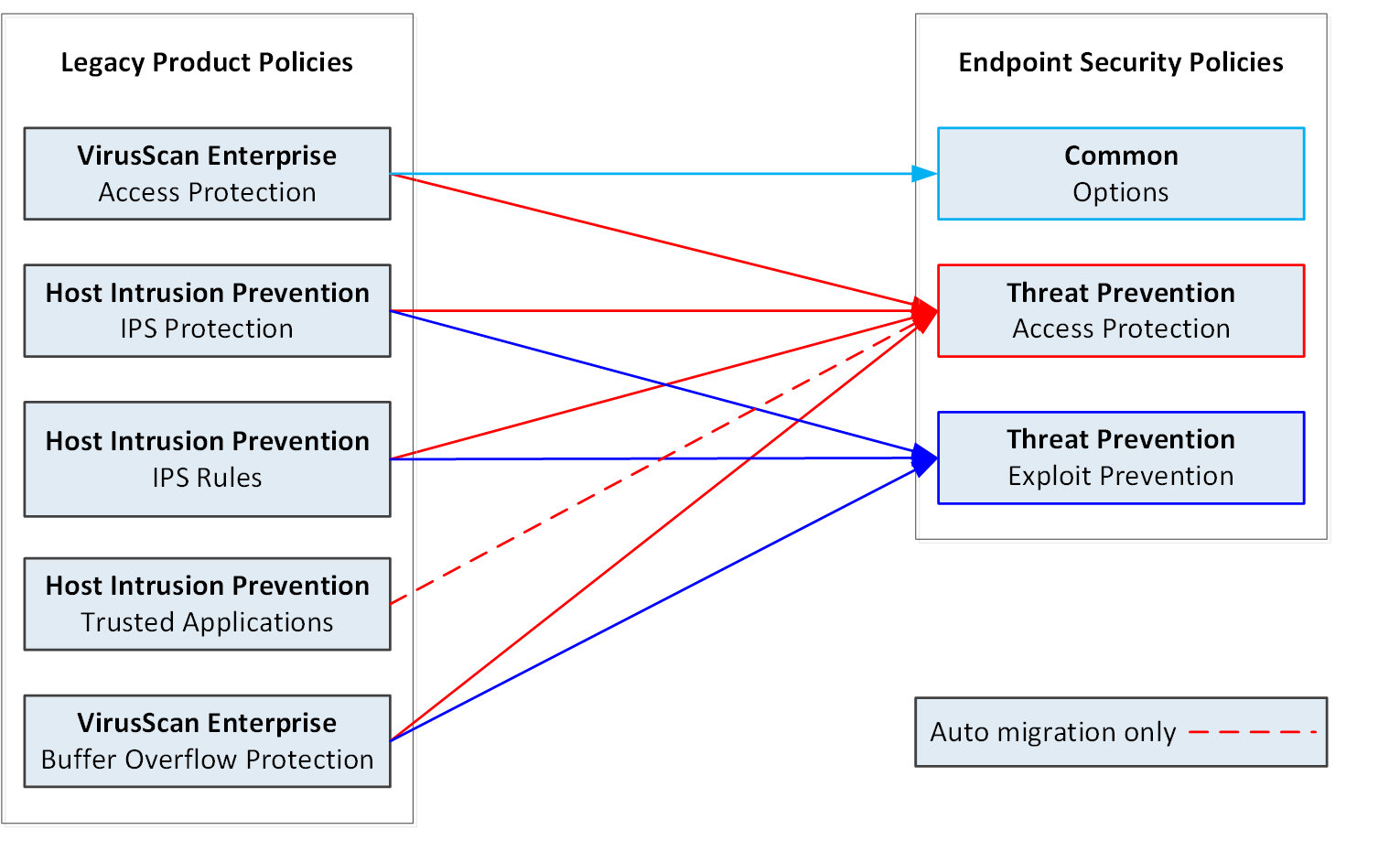
Access Protection, Buffer Overflow Protection, and IPS Rules policy settings from VirusScan Enterprise and McAfee Host IPS migrate to two Threat Prevention policies and the Trellix Endpoint Security (ENS) Common policy.
These policy types are migrated to the Access Protection policy in Threat Prevention:
- McAfee Host IPS — IPS Rules (Windows and Linux)
- McAfee Host IPS — Trusted Applications (Automatic migration only) (Windows and Linux)
- VirusScan Enterprise — Access Protection
These policy types are migrated to the Exploit Prevention policy in Threat Prevention:
- McAfee Host IPS — IPS Rules (Windows and Linux)
- VirusScan Enterprise — Buffer Overflow Protection
The IPS Rules policy is a multiple-instance policy. All source instances of the IPS Rules policy are merged and migrated to a single Access Protection policy and a single Exploit Prevention policy in Threat Prevention.
For more information, see the IPS Rules migration and Changes to migrated settings appendixes.
Trusted Applications (Windows and Linux)
Automatic migration moves settings from Trusted Applications in the McAfee Host IPS General policies to the Access Protection policy in Threat Prevention.
- Trusted applications where Trusted for IPS is enabled migrate.
- Trusted applications where Trusted for Firewall is enabled do not migrate.
If you migrate settings manually, you need to add the settings from Trusted Applications to the migrated Access Protection policy.