In-line monitoring ports can be configured as fail-open, fail-open active, or fail-closed. The built-in G0 monitoring ports and 4-port 100/40 Gigabit SR MTP/MPO interface module require the use of external active fail-open (AFO) kits for In-Line Fail-Open Active configuration. 6-port RJ45 10/1 Gigabit Ethernet interface module and 8-port 10/1 Gigabit fiber interface module, and 4-port 100/40 Gigabit fiber (with internal fail-open) interface modules (that is, 100/40 Gigabit SR MTP/MPO, 40 Gigabit LR4, 100 Gigabit LR4, and 100/40 Gigabit BiDi) come with a built-in fail-open functionality.
Monitoring ports fail-close, which means the flow of traffic will stop if the Sensor fails. To allow traffic to flow uninterrupted, you might use an external AFO kit and configure the ports in In-Line Fail Open - Active, or configure the ports in In-Line Fail-Open mode to allow uninterrupted traffic flow using their internal fail-open functionality. For instructions, see the subsequent sections of this chapter.
This section provides the steps to connect the Sensor's monitoring ports so they fail-close.
Plug the cable appropriate for use with your transceiver module into one of the Monitoring ports, for example G0/1.
Plug the cable appropriate for use with your transceiver module into one of the Monitoring ports, for example G0/2.
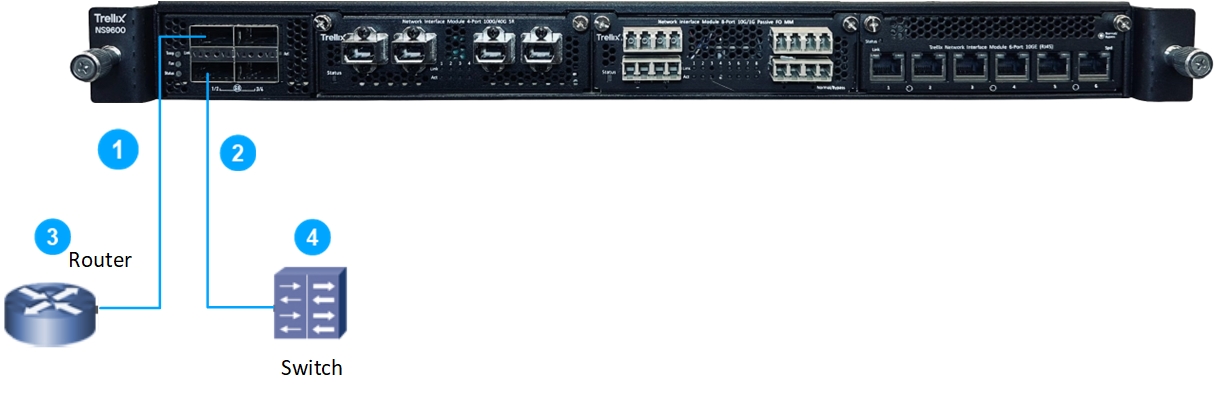
Connect the other end of each cable to the network devices that you want to monitor.
For example, if you plan to monitor traffic between a switch and a router, connect the cable connected to 1 to the router (3) and the one connected to 2 to the switch (4).