Prerequisites:
To configure SNMP traps, you will require a server that will act as an SNMP server. The SNMP server can be any Windows or Linux system installed with an MIB browser, such as iReasoning.
Make sure your fail-open switch IP address can be reached within the network.
Make sure your SNMP server and fail-open switch can communicate.
In addition, you will need to obtain MIB files to decode alert codes sent by the fail-open switch. These files are specific to the fail-open switch and can be obtained by clicking on the following link: KB86247.
Note
The SNMP feature of your fail-open switch can only be used to send notifications through SNMP traps.
Steps:
Connect an RJ-45 cable to the Management port at the back of the fail-open switch.
Connect the other end to a network device so that the SNMP server is reachable through the network.
Copy the fail-open switch MIB files to a suitable location on the SNMP server.
Set up the fail-open switch IP address, network mask, and SNMP manager IP address by logging on to the web interface. For details about logging on to the web interface, refer to the section Access the fail-open switch web interface.
Note
You are also able to configure various other parameters specific to SNMP traps. For details about these commands, refer to the section (Optional) Configure fail-open switch parameters.
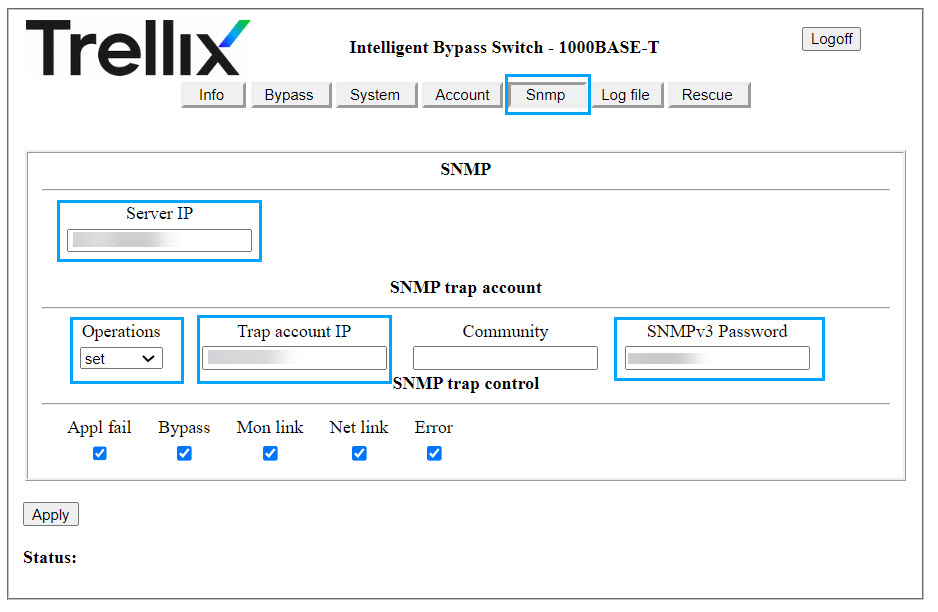
On the web interface, click the SNMP tab.
The SNMP configuration page appears.
WW
To configure the SNMP server IPv4 address, enter it in the Server IP field.
The credentials used will be the default credentials for the fail-open switch.
(Optional) If you want to configure multiple SNMP accounts, in the SNMP trap account section, select set from the Operations drop-down.
Note
If you do not configure additional SNMP trap accounts, all traps will be routed to the main SNMP trap account you have set up here.
Enter the IPv4 address for the other account.
(Optional) You can specify an alternate SNMPv3 password for the additional SNMP server.
Note
SNMP Community strings are used only by devices that support SNMPv1 and SNMPv2c protocols. SNMPv3 uses username and password authentication, along with an encryption key. You can configure a community string if the SNMP software you use requires you to configure one regardless of the requirements in this user interface.
Click Apply to save your configuration.
In the SNMP server, configure these settings to enable SNMPv3 traps for the active fail-open kit.
USM user:
Trellix00Security level:
auth, privAuth algorithm:
SHAAuth password:
Trellix00Privacy algorithm:
AESPrivacy password:
Trellix00
Load the MIB file. If you do not have the appropriate MIB file, contact Trellix Support.
Make sure the SNMP server and fail-open switch can communicate through the network.
Result: You have configured your active fail-open switch to send SNMP traps to an SNMP server. You are also provided the option to configure multiple SNMP trap accounts. Access the SNMP server to view triggers.